Testing And the Art of Driving on Mexican Roadways
by Thaddeus Tripp Ressler
“Wait, what do you mean? There’s no test? All you need is ID?”
“Yes. This is Mexico. We are free here. If you make an appointment you can get in and out in fifteen minutes.”
Even though I had clarified what Gabby, my hostess, was saying, I wasn’t really comprehending what I was hearing. My rule dictated American brain could not accept the idea that you could get a government issued driver’s license without ever having taken a written or road test. Suddenly all the things I had seen started falling into place in my brain. I thought about the wild-west lane changes, motorcycles launching themselves across highways without even looking, and stoplights that apparently didn’t always mean stop. I thought about my father, laughingly explaining that Dominicans referred to speed bumps as “sleeping policemen,” when I told him about the ridiculous number of speed bumps on all the roads here in Mexico. Then suddenly, I began to laugh from deep down in my soul, the whole notion was so ridiculous. That said, it’s easy to see the ridiculousness of another nation’s systems without taking our own into account.
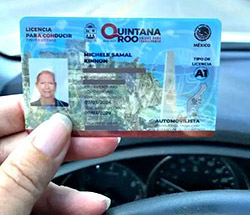 Growing up in New Jersey, a place where there is a rule, regulation, law, directive, and tax on everything that a person does, it seems crazy that you wouldn’t need certification to drive on public roads. Yet, those certifications have never stopped Americans from being terrible drivers. It does, however, give us the comfortable illusion of safety and competence. And this is coming to you from someone who has traversed the entire East Coast, all over the Midwest, and Southwest. I’ve also driven most of the highways, byways, state, county, and surface roads of the three largest metropolises of the United States, as well as a handful of smaller ones too. I have driven in thirty-eight of our fifty states, and I can say with absolute certainty that the United States has no shortage of horrendous drivers in it. Each and everyone of them went through “thorough” training and testing.
 There are certain customs and courtesies here in Mexico that would seem strange to us in the United States. For example, driving on the shoulder of a highway in the US will, at the very least earn you a traffic stop and a ticket. Here, it is common courtesy to drive on the shoulder, so that people can pass. Not that a double yellow line would slow a Mexican driver down necessarily, they appear to be more of a suggestion of a boundary than a hard and fast rule. Case in point, I was in a bus that passed a car, that was passing another car, that was lazily driving halfway into the shoulder. This was not on an empty highway either, there were cars coming from the opposite direction, on the shoulder, but still. That happened on the bus ride I took from Puebla to Zacatlán on my way back from Oaxaca. It was one of a dozen moments on that trip that my breath caught in my throat, and my jaw went slack.
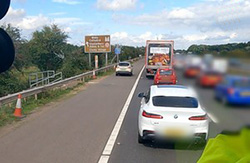 On that trip I had opted for a front row seat, thinking this was going to be like the luxurious coach I had taken in the opposite direction. It was not. More than that, the driver was not the same relaxed gentleman we had on the way to Puebla. This man drove like he had just stolen the bus and was trying to flee the country in the most convoluted way possible. Every turn felt like a test of my core strength. I averted my eyes when he overtook vehicles, I braced for impact every time he came right up to the bumper of slow-moving vehicles that hadn’t moved to the shoulder fast enough. If I had pearls, they would have been clutched every time he took a turn that, by my estimation, came far too close to other vehicles or buildings, which was literally every single one of them. Yet, the man never flinched, never stopped, there were times that he didn’t even stop to let people jump on. Cucumbers dream of being this cool. He was as sure in his movements as a surgeon doing the routine removal of a mole. The only thing that ever seemed to slow him down were the topes (pronounced TOE-pace), the Mexican word for speed bumps.
 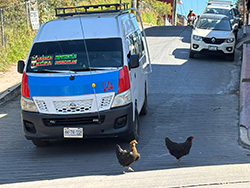 These “sleeping policemen”, are ubiquitous in Mexico. The only place they don’t exist is on the high speed toll roads. The smaller the road the sooner you can expect them. For instance on the one-way streets of Zacatlán, they come at least once per block. You can count on them popping up least every kilometer on a bigger road. They’ll stretch them out further in farm country, where you mostly get them at crossings or more populated areas. I even saw a couple of them on dirt roads, which makes no sense to me. They vary in age, height, shape, and markings. Some are a serpentine row of steel half-spheres crossing the road, some are eight inch wide asphalt rows with a slope so sharp it feels vindictive. Others are tall and long enough to make a bus rock like a boat in stormy seas. To top it all off, the Mexican government doesn’t seem to value the universality or consistency of road signage. Nor do they seem to care if these topes have markings on them that signify their presence at all! On more than one occasion these unmarked topes afforded me an unexpected Spanish lesson in the proper use of foul language.
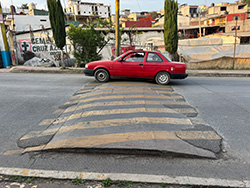 I got to experience highway topes on day one with Dick Davis, when we took a taxi from Mexico City to Zacatlán. There must have been at least a hundred of them in the three hour drive. Apparently there aren’t as many of them in Mexico City, because it seemed like our cabby’s first experience with them too. Many of them were hit at speeds well in excess of what his little car’s suspension could handle. Each one earned a quiet curse and/or grunt from all three of us. In one case, Dick and I hit the roof of the cab with enough force to stun us and make us slide deep down into our seats for fear that it might happen again.
 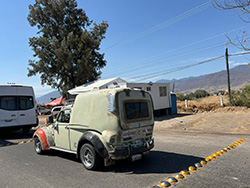 Lying in bed in Oaxaca, weeks later, I was trying to figure out how I could make sense of all of this, especially those damn topes. I thought about the fact that Mexico is a country that enjoys its drinking, a lot, and their drivers don’t go through testing. My mind reeled at the idea that swearing to a government official that you know how to drive, plus a birth certificate and proof of address, was all that was necessary to get a driver’s license. From that angle though, all those topes started to make a little more sense to me. It’s hard to cause a massive car wreck when you can’t get over 35mph. Could you, sure, but it had to limit the possibility tremendously. Hell, I’d be willing to bet that most of the drunk driving accidents are caused by very short people, because as Dick and I can attest, smacking your head into the roof of a car is a sobering experience.
The funny thing is that in the month and change that I’ve been here, I’ve only seen one accident, and it was a minor one that didn’t even bend a fender. Everyone, except the cabbies and bus drivers, seem to drive very defensively. At intersections they’re all very courteous, and on the highways they’re constantly moving out of the way and paying attention to who’s ahead and behind. Are there crazy drivers and bad drivers, of course, but I don’t think I’ve seen anything here that was all that crazier than in the United States.
I myself have been the crazy driver. When I was living in Los Angeles, I drove on the freeways like I was trying to evade hitmen in a Hollywood movie. I’ve seen horrific accidents, reckless driving, and just plain stupidity. So then, does having a license that came with a learners permit, training, and testing make us any better, or at least better drivers? I don’t know the answer to that. I will say this though, that crazy bus driver got us into Zacatlán thirty minutes ahead of schedule, without a single scratch. On a day that I spent eight hours on a bus, I appreciated that. Although, next time I might opt for a seat somewhere in the middle of the bus, a seat-belt, and an eye mask.
__________________________________________________________________________________________________________________________________________