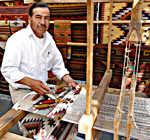
Zenon Hipolito, master weaver
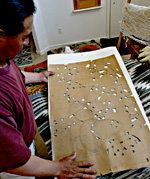
Stenciling

Red and black hanging
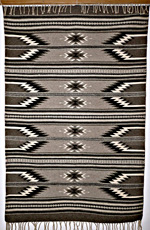
Horizontal hanging 3
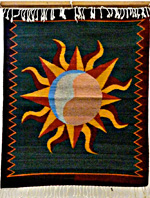
Sun hanging

Horizontal hanging 1
by R.W. Davis
The pre-Hispanic ruins at the Mitla Temple Complex in Oaxaca, Mexico reveal a direct connection to the modern Zapotec weaver’s art. Mitla’s tall walled avenue, sculptured in bas-relief, dwarfs the visitor. Three broad bands of geometric mosaic designs, pieced together in polished stones, contain the lasting record of encoded knowledge and a glimpse into Zapotec beliefs. Repeating patterns from the past are preserved in the threads woven by modern artisans whose textiles preserve and celebrate Zapotec beliefs. Ironically Mitla, Place of the Dead, is alive in the carpets of the living.
Along the avenue in Mitla the lower band is the sacred calendrical lightning design. The middle shows the greca, the 4 Steps of Life or Passages: birth, childhood, youth and maturity. The top band is composed of stylized geometric caracols (snails) that symbolize the continuation of life. Zapotecs believe grecas link all forms of life together.
Figures and symbols, neglected for hundreds of years, relics from destroyed temples, are features in Oaxacan carpets. Weavers follow tradition without full knowledge of their origin or significance. Investigators have speculated that patterns, stylized feathers and scales, birds and snakes, may symbolize energy of the sky, shaking of the earth and represent the duality of the body and spirit interlocked in the pan Mexican icon Quetzalcoatl, the Feathered Serpent.
Zenon Hipolito, a master weaver, born May 7, 1956 in Teotitlan del Valle, Oaxaca, lives with his wife Rita and children in Lathrop, CA in a modern ranch styled home. He has 3 treadle looms in the living room, which seem a perfect symbolic melding of the modern with the ancient as is his art. To explain the loom, he showed a sketch and labeled the parts in combined English, Spanish and Zapotec.
His treasure is a carpet woven by his father Ponciano, a traditional black-red, two-color design with a flower center. Once Zapotec weavers used only the black-red combination, but over time with collectors and tourists, art and use influenced color. Carpets became wall hangings.
The flower at the center of the treasured carpet symbolizes nourishment. “We honor the flower because they represent food.” The bloom of the calabaza (squash) is a Zapotec favorite. Colors are symbolic. Red represents the sun or day; black the night, but the dichotomy may also extend to male-female, good-evil, vitality-rest. Secret vegetable dye color recipes are passed from generation to generation, and like Napa Valley vintners one family can identify another’s work by subtle differences. “We can tell right away.”
Zenon Hipolito crafted his own looms, the largest being 10 feet wide. He brings a portable 4x4 foot loom to art fairs and demonstrates his craft, which requires constant attention to the mathematics of the design. Geometric figures are complex, but the curved figures, whether a bird or flower or sun or moon or animal image, are the most difficult to weave and likely to be least appreciated by the casual viewer. “When did you begin weaving? I asked Zenon. “When I was 8,” he said. His father, a master weaver taught him, and Zenon had to learn the most difficult designs first, the curves. How often do we challenge the student with the hardest first, I wondered? Zenon’s eyes gleamed and his Mona Lisa smile turned radiant when he spoke of his father, who died in 2008.
Yarn and Dyes:
“The best yarn comes from Chichicapan, a town near Oaxaca. They raise their own sheep and have the best handspun wool.” Wool, sheep and goat, is used in its natural color or is naturally dyed in earth tones. A bluestone is ground to make indigo, yellow comes from the onion, green from the pepper tree, and walnuts or pecans provide brown. The cochineal insect is dried and ground to create a deep red.
Symbols, Elements of Life:
One may see a cruciform and think of the cross, but it’s a compass indicating cardinal points and the Elements of Life: earth, sun, water and air. Browns and grays are earth colors. Reds and yellows honor the life giving sun. Blues and green represents water, and white air. Zenon showed me a carpet with the sun at the center, which was composed of 4 elements and colors. I was thinking phases of the moon and sun. “The moon is in eclipse,” he said. But a sliver shadowing the crescent moon was a deeper blue. “Every time my mother saw an eclipse she put water outside to relieve the sun.” This personal experience became part of the carpet.
Inspirational figures:
A carpet may use any number of aesthetic elements, stylized geometric figures, negative-positive images created by designs and offsetting adjacent colors. “The butterfly represents long lasting life and the caracol (snail, stylized spiral) we believe continues life, your culture goes on and on and on. The center is energy, our belly button, Mother Earth.” Patterns of 4 repeat, as there are 4 steps in life. Checkerboard crosses using squares and triangles symbolize the life force and energy. The cloud motif, a symmetrical pattern of small squares arranged from the center point of the cloud in a 6–4‑2 ratio is a sign of plenty and abundant harvest. Repeating triangles in an arrow pattern, stylized scales or feathers, are signs of long life and energy. Butterflies, geometric Xs or 3s back to back, are also longevity symbols. The lightning pattern contains sacred calendrical signs. Squares and diamonds incorporate contrasting elements often using colors, arrows and shading. Some symbolize God’s eyes and insight into the future.
Signature:
Historically weavers did not sign their carpets, but collectors have made requests and some weavers are encoding their oldest name in their newest designs, their birth date.
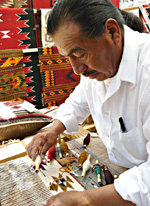
Hipolito weaving
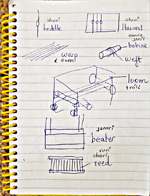
Hipolito’s Notebook
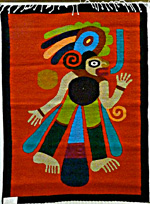
Monkey hanging

Guest looking at hanging
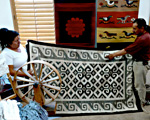
Hipolito and lady checking hanging
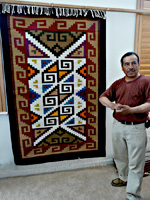
Hipolito with hanging