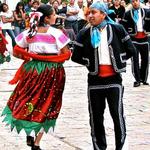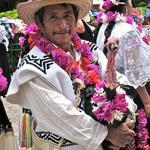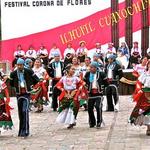

Festival Corona de Flores featured costumed dancers in Plaza Armas. The major focus of our visit to Zacatlán was the Crown of Flowers Festival. In the Náhuatl language of the indigenous performers, the Festival is called Ilhuitl Cuaxochitl. On the stage are the Queen of the Festival and her princesses, bedecked with flowered crowns and necklaces resembling Hawaiian leis. Groups of young students in gorgeous costumes danced the first day. The men above wear charro outfits, lacking only the huge round sombreros. The women wear the national colors of Mexico: red, white, and green.
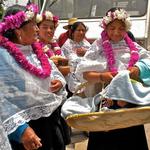
Admiring a new baby. The infant’s mother cradles it in a traditional carrier called a chita in Spanish, or in Nahuatl, huácal. She wove the chita from rattan and a fibre from the maguey plant called ixtle. It has a handle which can be used to carry it over the shoulder or suspended from the head.
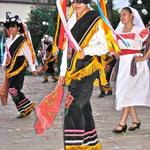
Danza de los Negritos. The costumes for the Dance of the Little Blacks included a hat I found particularly interesting. In addition to its flower adornments, the hat carries a long black fringe that hangs in front of the eyes of the performer, almost as a mask. Both male and female performers wore the costume, and the only way to tell the difference is the style of shoe. The dancer in the foreground above appears to be a female. The long ribbons of the hat and gold fringes of the sash and pants swayed and rippled with the movements of the dancer.
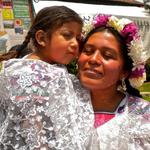
A mother and daughter enjoy a moment together in the afternoon sun. In many indigenous cultures, mother and daughters–including even tiny girls–wear the same style of traditional clothing, topped by the filmy shawls. Photo by Mary Carmen Olvera Trejo.
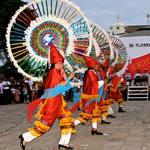
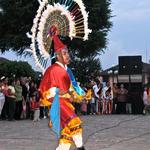
Los Quetzalines climaxed the first evening’s performance. The headdresses in particular were spectacular. The feathered hats imitate the plumage of the Quetzal bird, a sacred animal among many prehispanic cultures. Quetzals are found throughout southern Mexico and Central America. Quetzalcoatl, or the plumed serpent, appears in the myths of Toltecs, Mayas, and Aztecs.
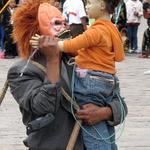
Quetzalin steps out. Los Quetzalines danced vigorously and their lines surged back and forth across the broad, open plaza. Once again, both males and females wore the same costume, identifiable only by their shoes. Danza de los Arcos y Tejedores. All the participants in the Dance of the Arcs and Weavers here were male, ranging from teenagers to elderly men. The arcs of flowers they carry symbolize the flowering plants of May. They danced in pairs, in parallel lines, and ultimately formed up for what appeared to be a May Pole dance, which you will see later in this posting. While their dance clothing was less spectacular than the students from the previous day, Mary Carmen assured me that this was the “real thing.” These people were performing traditional dances that had come down to them from their ancient prehispanic ancestors. Note the man in the monster mask in the upper left of the photo.