Beautiful Mud & The Pork Of Dreams
by Thaddeus Tripp Ressler
To understand the arts and crafts of the small towns in and around Michoacán you have to understand how they originated. Vasco de Quiroga, the first bishop of Michoacán(1536), was a fascinating character in Mexican history. He is credited with bringing peace through prosperity and religion to the rebellious Purépecha tribes in the region. Utilizing Thomas More’s Utopia as a loose model, he “congregated” the indigenous tribes into towns. Each town was then taught specific crafts which became their mainstay. For example, pottery crafts went to Capula. Tzintzuntzan, being right on Lake Patzcuaro, got reed crafting for things like mats and baskets. Santa Clara, of course, was assigned copper. Quiroga itself theoretically got lacquered wood crafts, but everyone knows it as the home of carnitas.
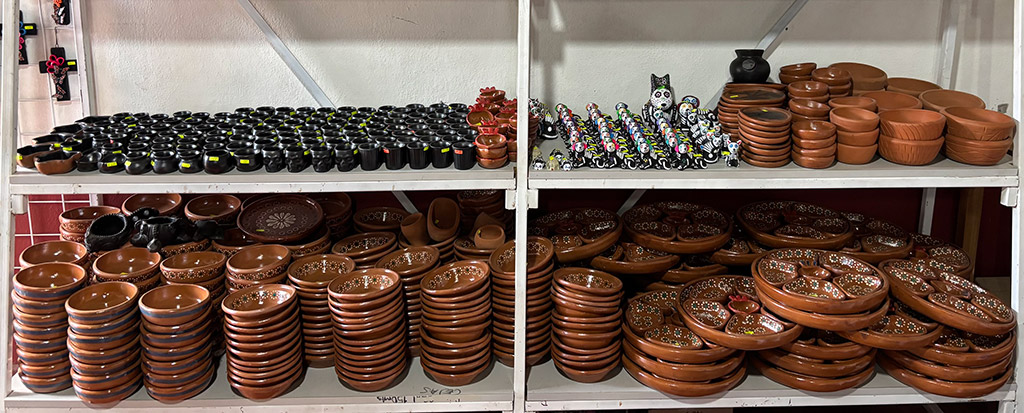
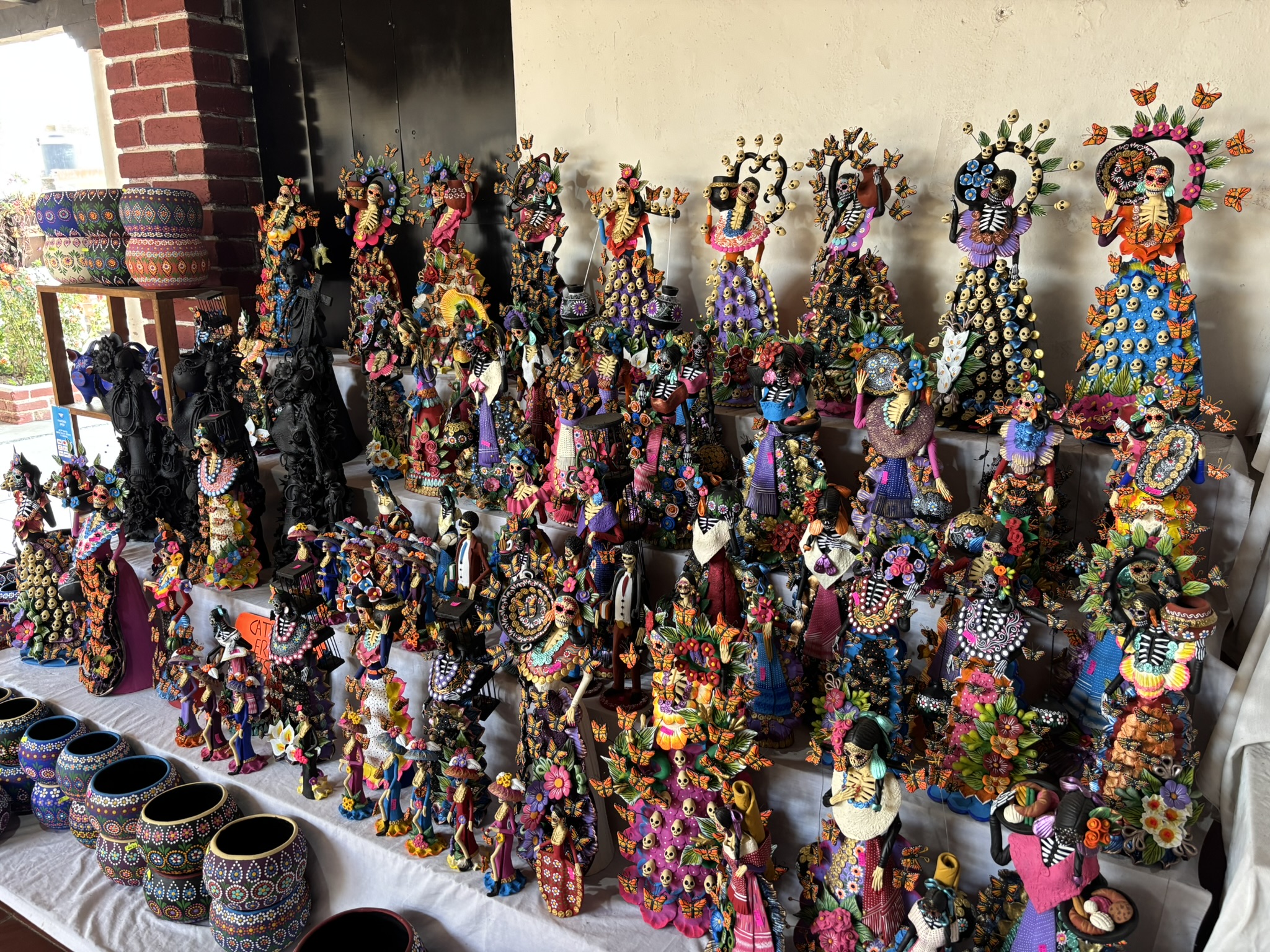
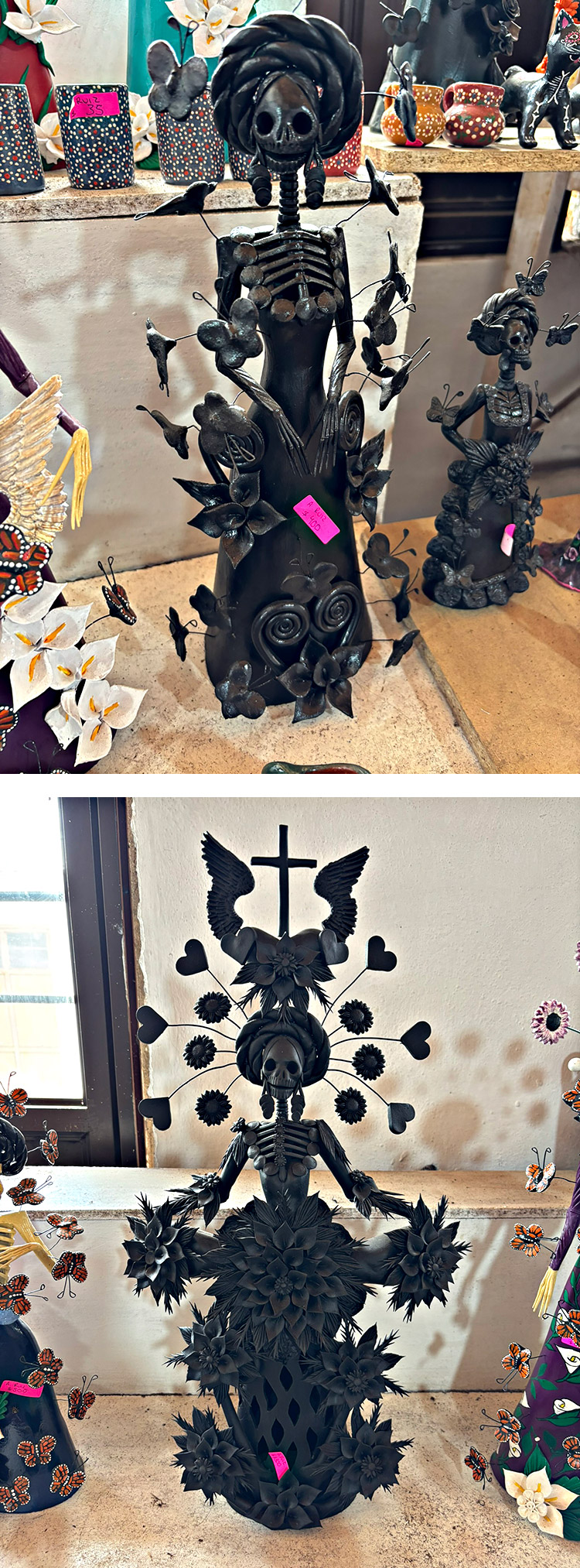 Karina, my most excellent tour guide and hostess, took me to the little town of Capula first. The dusty streets were dotted with little shops showing off their mugs, cups, plates, serving dishes, comals, pots, and figurines. The figurines have definitely taken over their trade. With colorful Catrinas, that have become synonymous with Día de Muertos taking center stage. Every storefront had the Catrina figures and skulls of different varieties on their shelves. Most were brightly colored, some were unpainted brown clay, but some of my favorites were pure black clay with incredible attention to detail.
Originally Catrinas (Spanish for dandy) were calaveras (skulls or skeletons) created by José Guadalupe Posada to show the macabre egalitarianism of death. Regardless of status, death comes to us all. The first to be published was the Garbancera, or a female garbanzo bean seller, in a 1913 broadside who the accompanying text, which Posada had nothing to do with, portrayed quite negatively due to the ongoing Mexican Revolution. It was thought that these garbanceras were traitors dressed in European fashions and selling a Spanish import. Later these same pictures would take on a whole different context when Diego Rivera was introduced to them and popularized them in the 1940’s. In the mixing of cultures, dress, and ideas, they became a symbol of national identity.
After walking around town for about a half hour in the hot sun, we realized it might be time to get some “Jesus in our lives.” Churches in Mexico are not only centers of refuge for the devout, they are also incredibly beautiful artistic creations, and as a bonus, at least ten degrees cooler than the outside temperatures. And while I may not be Catholic, I have always appreciated the Catholic attention to artistic detail in their churches and cathedrals. The church in Capula did not disappoint.
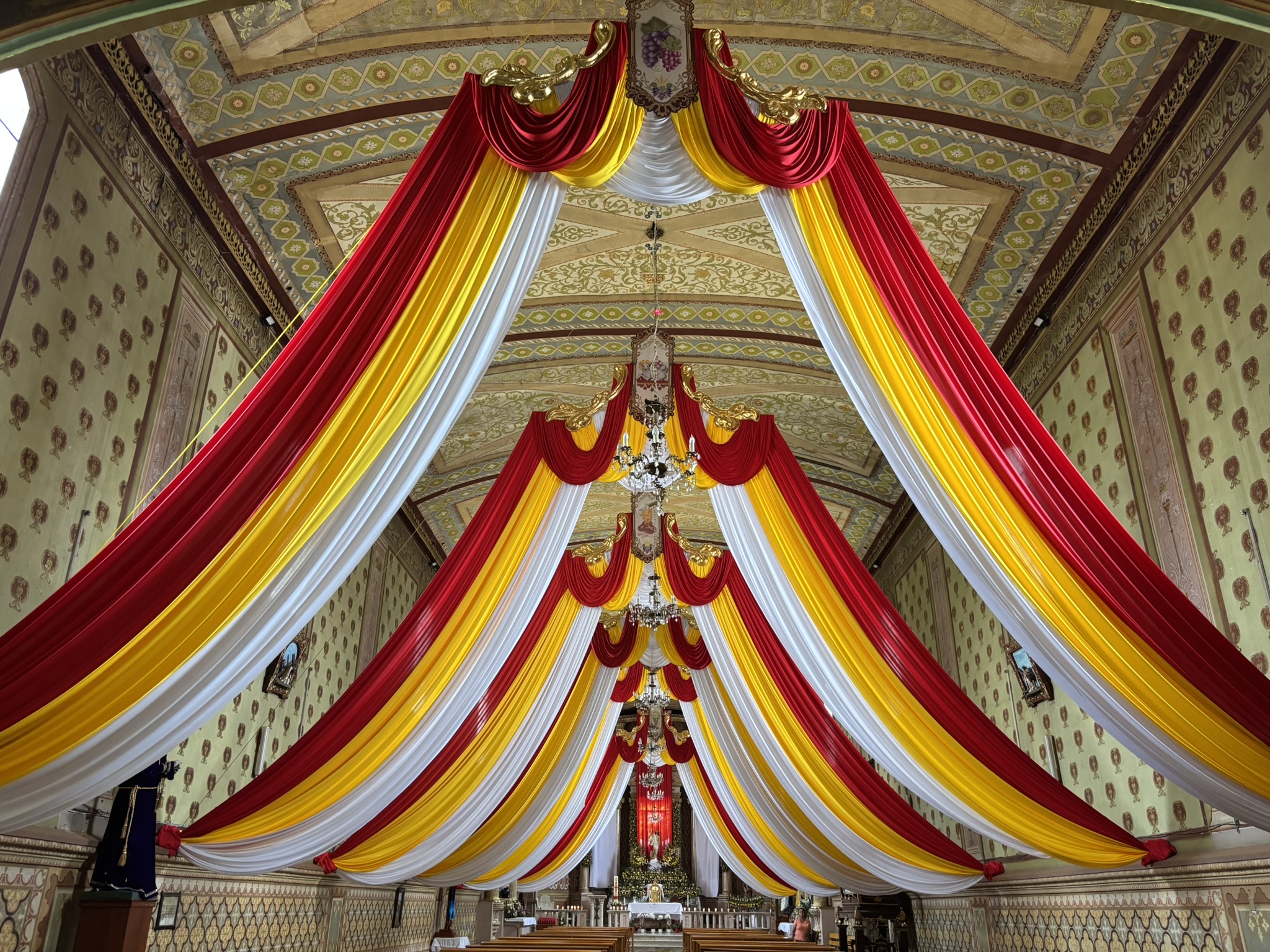 The most striking part were the six large boldly colored draperies hanging from ceiling to either wall. Done in the bright red and yellow of the Michoacán flag, with a stream of white to represent spirit on the inside. The walls had several sections of repeating patterns running the full length of the church, while the ceiling repeated vines and leaves broken into geometric designs. I think it shocked me because it’s such a small town, and to be honest the outside of the church was a touch drab. It really shouldn’t have though. Churches in Mexico, especially in smaller towns tend to be the focal point of social life.
 After that, we realized that we had taken in all of Capula and it’s pottery market. Karina asked if I was interested in going to Quiroga for lunch. Before she finished the sentence I cut her off with an enthusiastic, Yes! She jumped and laughed at the force of my enthusiasm. Then again, few understand my love of all things pork, and carnitas is high on that list. Whenever someone asks me what my favorite thing to cook is, I go into a Forest Gump style litany of mostly pork dishes. Without pork fat in my life, everything seems gray and lifeless, and apparently I’m not the only one that feels this way.
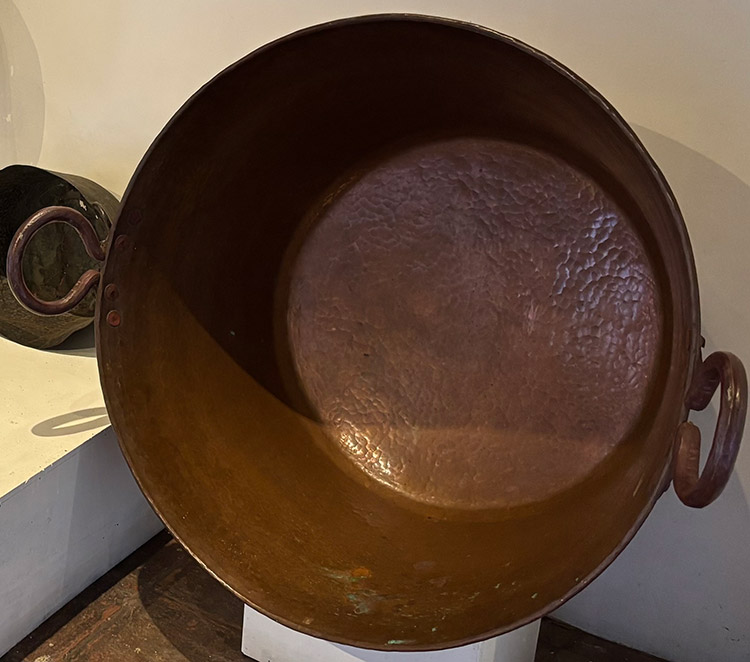
In Michoacán they say that you can only really make the classic carnitas in a copper pot. The copper pots that made Santa Clara del Cobre famous to be precise. Most of the pots you find for sale in touristy areas are relatively thin, like the ones you might find in a French kitchen, which is perfectly fine for the home cook. However, for industrial scale cooking you have to turn to the thicker ones that I saw proudly displayed at the museum. They’re nearly a half-inch thick hammered copper. These are no-nonsense workhorse pots that will sit over a wood, charcoal, or gas powered fire for hours every day of the week, slowly cooking down thirty to forty pounds of spiced pork in it’s own fat and juices. If you couldn’t guess, this is one of my favorite dishes in all of Mexico. There’s nothing quite like pork confit, or pork cooked in it’s own fat, and this is simply the Mexican expression of that classic dish. And I was getting to have the fortunate experience of eating carnitas in the home of carnitas.
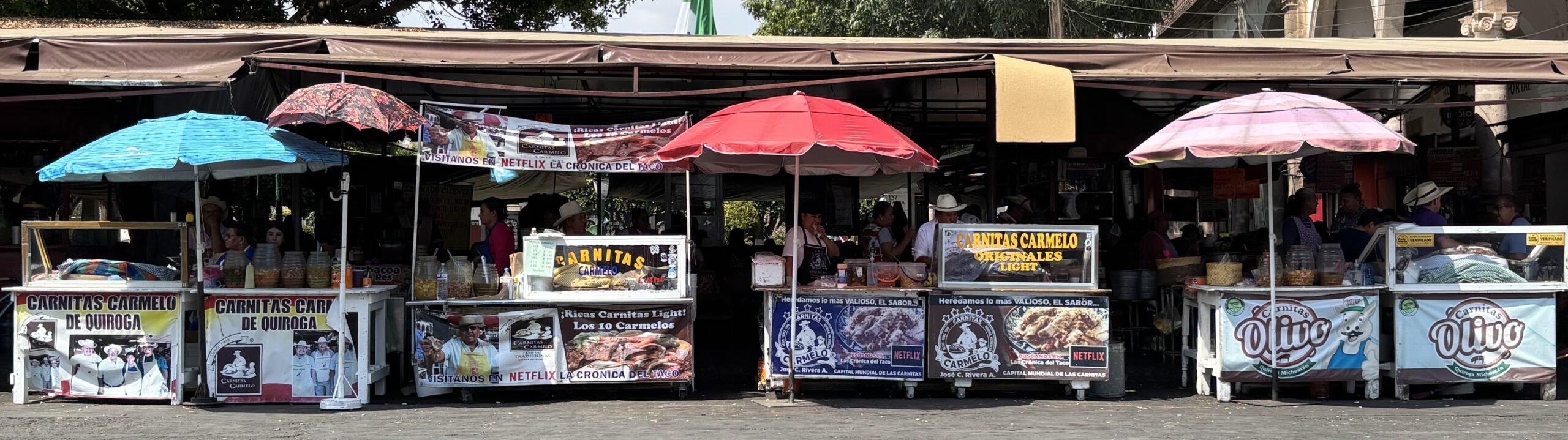 In Quiroga, in the center of town, there is a lineup of carts, tents, and stalls where the food vendors have taken over. It feels like a crowded farmers market filled with cooked meat smells, right up until the first vendor starts shoving a soft tortilla jam packed with carnitas uncomfortably close to your face. My Spanish is still remedial, but I can tell a food sales pitch from a mile away, and this guy was two feet from my person, with the taco inches from my face. For a moment I was put off, but then I realized what I was being prudish about. I mean who cares if this loud sweaty man was in my personal space, he was desperately trying to feed me food that I was desperately wanting to try. I took the taco in hand and bit off half.
The tortilla itself was impossibly soft, and followed up by a beautiful explosion of spiced porky flavor with just a touch of fatty goodness. It was both tender and juicy without sacrificing the texture of being meat. The liquid fat that remained after cooking transferred flavor directly to my tongue. I moaned. Karina eyed me suspiciously at the sound, but I couldn’t give an explanation in my native language much less in a language I’m barely capable of paying a compliment in. We didn’t stop walking though.
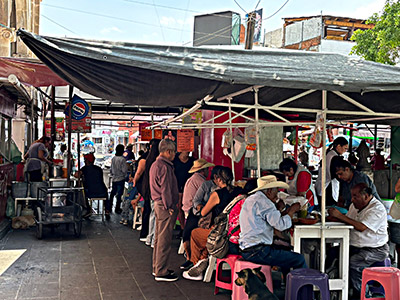 The guy handed me a taco with an assurance that his were the best in all the land, while his waitress tried to usher us to a communal seating area, all while we were walking, eating, and checking out the other places. Then two more hawkers approached us, speaking loudly over each other. One attempting to shove another taco at me, while the other was telling us about her barbacoa, a dish I still need to try. Now, I’m not squeamish by any means, but I’m also not accustomed to being accosted by grown men trying to shove food directly in my mouth. It’s a touch overwhelming, but I might suggest, that if it ever happens to you, just go with it. These are people concerned with feeding you, just trying to give you food, how bad is it really going to go? I took the second taco. It was delicious too.
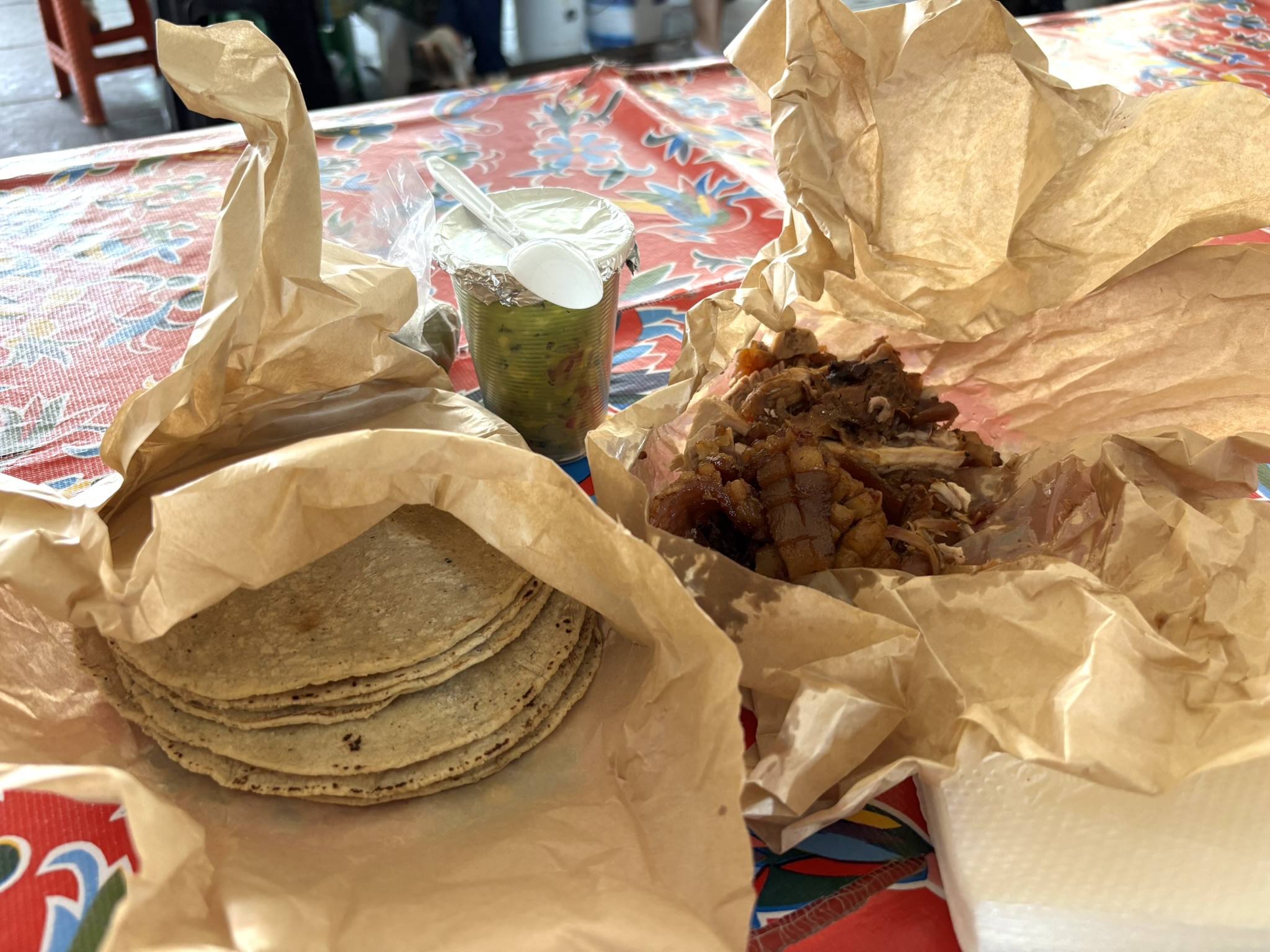 We decided to go to the first one, since, why not? When we circled back the waitress ushered us to a table under the canopy. There we found out we would be ordering by the kilo, like the drug that carnitas are. Being an American, metric is not my strong suit, but weight is a pretty easy one(1k=2.2lbs). I felt like two pounds of meat, even one I love as much as carnitas, might be a bit much. We went for a half kilo. That came out with a stack of fresh hot tortillas, a plastic cup filled with guacamole, and pickled Serrano peppers. I was in my happy place for the next fifteen minutes.
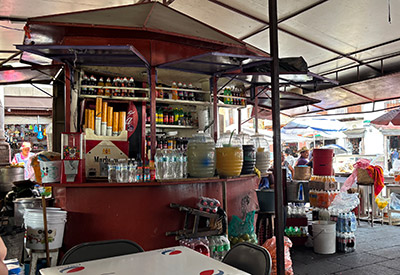 A boy came over from the drink stand, which is a separate business from the meat vendors, but works in conjunction with them. This seems to be a thing that happens often in a lot of these communal vendor areas. Drinks are separate from food, but they all work together to ensure business flows smoothly. When I was in Oaxaca with Gabby, we went to an indoor market that had a “smoke alley” where you order your meats, sit down, then drinks and tortillas are offered to you, but all by different vendors. Everything was à la carte and paid separately. It can be a bit confusing at first, but once you get the process, it makes sense.
Well Karina decided to tap out after two tacos. I, on the other hand, gladly finished off the rest of that pound of meat. Now, one interesting thing I found in Mexican carnitas versus what I’ve had in the US, there was skin, or chicharrón. Cooked down till it was falling apart, but completely saturated in all the herbs and spices that went into the dish. It ended up being my favorite part. I made sure to get at least a little strip of chicharrón in every taco.
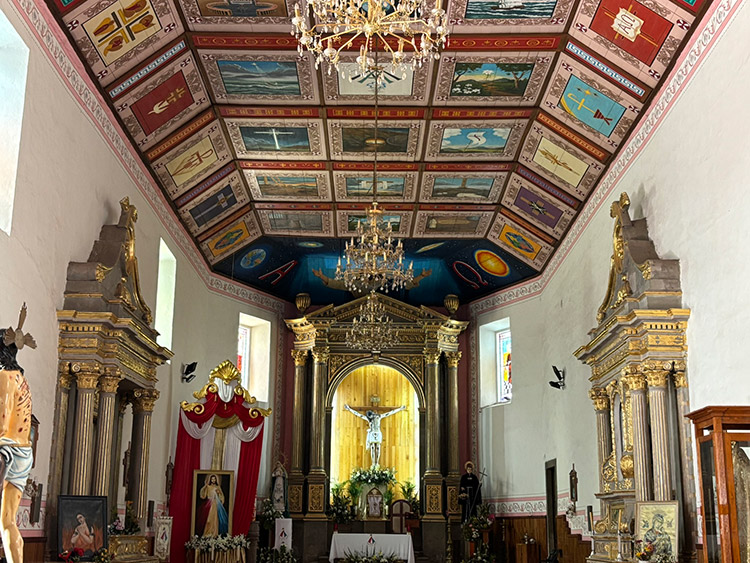 After eating all that pork, I needed to go for a walk. Which with any good Mexican town leads you straight to church. The ceiling was covered in the painted and lacquered wood that the town is supposed to be known for. The designs were beautiful and there was a rich depth of color to them. Each panel had an individual theme, some were symbols of Christianity, others were biblical scenes. Above the altar was a scene of Jesus, arms outstretched
 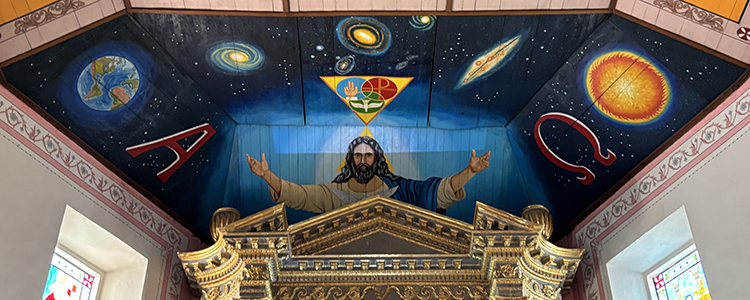 toward the congregation, with the universe in the background. As beautiful as the artwork was, I couldn’t help but think that there was room for debate as to what could be considered the greater art form in town. Sure, beautiful art feeds the soul, but great culinary art feeds the soul and fills your belly. For me it comes down to this, to really remember the beauty of the church I will need to look at some of the pictures I took, however the beautiful flavor of those carnitas will haunt my dreams for eternity.
__________________________________________________________________________________________________________________________________________